Sector by Sector: The Industries Quietly Walking Away From Vision AI in 2025

Sector by Sector: The Industries Abandoning Vision AI in 2025
There are no press releases when a vision AI program dies. There is no farewell announcement, no retrospective published in an industry journal. The cameras stay mounted. The servers stay racked. The models sit in version control, tagged with timestamps that grow older by the month. And somewhere in a budget spreadsheet, a line item quietly disappears.
This is how vision AI abandonment actually looks in 2025: not dramatic, not public, but persistent and accelerating across specific sectors of the American economy.
PersistVision surveyed technology leaders, analyzed deployment data from public procurement records, and spoke with program leads at organizations that have recently shelved vision AI initiatives. What emerged is a map — not of geography, but of industry — that reveals where the collapse is concentrated, why certain verticals cannot sustain deployments, and what that signals for the next generation of investment decisions.
Retail: The Highest Abandonment Rate in Any Consumer-Facing Sector
Retail entered the vision AI era with enormous ambition. Cashierless checkout, shrink detection, planogram compliance, foot traffic analytics — the use cases were compelling, the vendor ecosystem eager. By early 2025, however, the sector has logged what several analysts now describe as the highest abandonment rate among consumer-facing industries.
The reasons are structural. Retail environments are extraordinarily dynamic: seasonal resets, promotional displays, staffing changes, and shifting customer demographics all conspire to degrade model performance faster than retraining cycles can compensate. A shrink detection model calibrated for one store layout becomes unreliable within months of a floor reset. A foot traffic system trained on pre-pandemic behavior patterns has little relevance in a post-pandemic shopping environment that continues to evolve.
"We spent fourteen months deploying and tuning," said one former program lead at a mid-size regional grocery chain, speaking on condition of anonymity. "By the time we were satisfied with accuracy in one region, the stores in another region had already changed enough that we were starting over. We never reached the point where the system was actually maintaining itself."
The result: dozens of grocery, apparel, and big-box retailers have quietly returned to human-based loss prevention and manual compliance audits, absorbing the sunk cost rather than continuing to fund a maintenance burden with no clear endpoint.
Healthcare: Regulatory Friction Meets Operational Complexity
Healthcare presents a different abandonment profile. Vision AI deployments in clinical and hospital settings are not failing because the technology underperforms — in many documented cases, the models perform well. They are failing because the regulatory and organizational infrastructure required to sustain them is not present.
FDA clearance pathways for AI-enabled medical devices remain slow and expensive. Hospital IT departments, already stretched thin managing electronic health record systems, lack the bandwidth to maintain inference pipelines. Clinical staff, whose buy-in is essential for any patient-facing technology, often remain skeptical of systems they cannot interrogate or explain to patients.
The abandonment pattern in healthcare is particularly costly because the deployments that fail tend to be the ones that reached the furthest into production. A pilot that never scales is painful; a fully deployed system that gets decommissioned after eighteen months carries both the sunk cost of deployment and the disruption cost of removal.
Several hospital systems in the Midwest and Southeast have shelved computer vision programs for patient fall detection and surgical site monitoring in the past twelve months, citing not performance failures but sustainability gaps: no internal team capable of managing model drift, no vendor willing to provide long-term maintenance contracts at acceptable cost, and no regulatory clarity on liability when the system produces a false negative.
Construction: A Sector That Adopted Fast and Abandoned Faster
Construction was an early and enthusiastic adopter of vision AI, drawn by clear use cases in safety compliance, equipment tracking, and progress monitoring. The sector also has one of the fastest abandonment cycles of any industry studied.
The problem is environmental. Construction sites are temporary by definition, which means every deployment is, in effect, a new deployment. A model trained on one site's conditions — lighting, dust, equipment configuration, worker density — requires significant retraining or replacement when applied to the next site. The economics of per-site retraining rarely pencil out for contractors operating on thin margins.
"You're essentially deploying a custom solution every time," noted a technology director at a mid-size general contractor in Texas. "The vendors sell you a platform, but what you're actually doing is building a new system on every job. The platform doesn't remember anything useful from the last site."
Large construction conglomerates with dedicated AI teams have found ways to manage this, but for the mid-market — which represents the majority of US construction activity — the maintenance burden is simply unsustainable. The result is a pattern of adoption followed by abandonment that is becoming reflexive rather than strategic.
The Sectors Holding On — and Why
Not every industry is abandoning vision AI. Manufacturing, logistics, and agriculture show meaningfully lower abandonment rates, and the reasons are instructive.
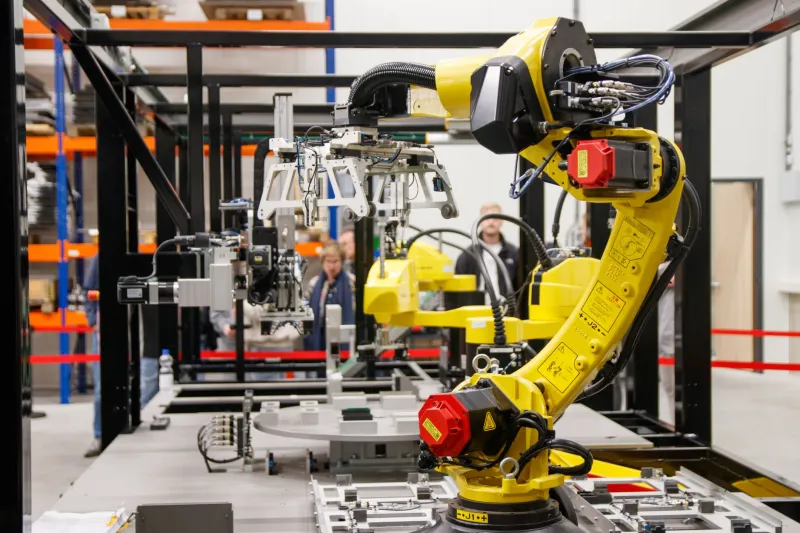
These sectors share a common characteristic: environmental stability. A manufacturing line does not change its lighting conditions seasonally. A grain elevator does not rearrange its layout for promotional periods. A logistics sortation facility operates under conditions that, while demanding, are highly controlled and predictable.
This environmental stability allows models to maintain performance over time without constant retraining. It also allows organizations to build institutional knowledge around their deployments — engineering teams that understand the system, operational staff that trust the outputs, maintenance protocols that have been tested and refined over multiple cycles.
The contrast with retail, healthcare, and construction is sharp. In those sectors, the environment changes faster than the organization's ability to adapt the model. In manufacturing and logistics, the reverse is often true: the organization's adaptation capacity exceeds the rate of environmental change, creating conditions where persistence is achievable.
What Serial Abandonment Signals
The pattern of repeat abandonment — organizations that have now shelved two or three vision AI initiatives — deserves particular attention. These are not organizations that tried once and failed. They are organizations that continue to invest, continue to fail, and continue to invest again without meaningfully changing their approach.
This cycle suggests that the problem is not with any specific deployment but with the underlying model of adoption itself. Organizations are evaluating vision AI through a procurement lens — selecting vendors, deploying systems, measuring accuracy — without building the organizational infrastructure required for long-term sustainability.
The sectors with the lowest abandonment rates are not necessarily the ones with the best technology. They are the ones that have built the organizational capacity to maintain what they deploy. That distinction — between buying technology and building capability — is the defining variable in whether a vision AI investment persists or becomes another entry in the graveyard.
For technology leaders evaluating new deployments in 2025, the sector map is a useful starting point. But the more important question is not which industry you operate in — it is whether your organization has built the infrastructure to sustain what it builds. Without that foundation, the technology's sector matters far less than the organization's capacity to persist.