Visual Intelligence Is Quietly Becoming America's Most Defensible Tech Advantage
The conversation around artificial intelligence in American boardrooms has, for the past two years, been dominated almost entirely by large language models. ChatGPT, Claude, Gemini — these names have consumed executive attention, venture capital, and press coverage in roughly equal measure. Yet while organizations debate the merits of generative text tools, a structurally more defensible class of AI is being quietly deployed across the country's most competitive industries.
Vision AI — the broad category encompassing computer vision, visual inspection systems, and multimodal image-understanding models — is emerging as the competitive moat that will define American industry leadership through the next decade. Unlike language models, which are rapidly commoditizing as open-source alternatives close the gap with proprietary systems, visual intelligence capabilities are proving far harder to replicate, transfer, or acquire cheaply.
Why Seeing Is a Harder Problem to Commoditize
Large language models are trained on text that exists abundantly on the public internet. The underlying data is, in a meaningful sense, shared infrastructure. Any well-resourced organization can approximate the capabilities of a frontier language model by fine-tuning an open-source alternative on domain-specific documents.
Visual AI operates under fundamentally different constraints. High-quality labeled image and video data is scarce, expensive to produce, and — critically — proprietary. A semiconductor manufacturer that has spent three years building a visual defect-detection dataset across its production lines owns something that cannot be scraped from the web or replicated overnight. That dataset, combined with the institutional knowledge required to label it correctly, constitutes a durable competitive asset.
This data asymmetry is one of the primary reasons American companies across manufacturing, healthcare, and retail are investing heavily in visual AI infrastructure right now. They are not merely purchasing a software tool. They are constructing a proprietary intelligence layer that compounds in value with every additional image processed and every additional human expert whose knowledge is encoded into the system.
Manufacturing: The Clearest Early Signal
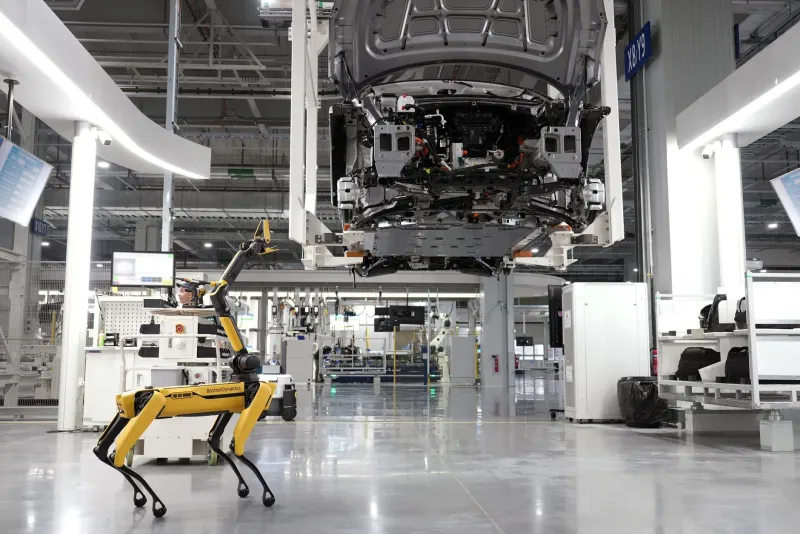
No sector illustrates the competitive logic of visual AI more clearly than American manufacturing. Domestic producers have faced persistent cost pressure from overseas competitors for decades. Labor cost differentials remain substantial, and broad-based reshoring efforts depend on closing that gap through automation and precision.
Visual inspection systems are central to that equation. Traditional quality control relies on human inspectors whose accuracy degrades with fatigue and whose throughput is inherently limited. Vision AI systems, by contrast, operate continuously, maintain consistent sensitivity thresholds, and generate structured data logs that feed back into process improvement cycles.
Companies that have deployed these systems at scale — particularly in automotive components, aerospace parts fabrication, and electronics assembly — report defect detection rates that exceed human performance by meaningful margins. More importantly, they are building proprietary defect libraries that encode years of manufacturing knowledge. A competitor entering the same market cannot purchase that accumulated visual intelligence. They must build it, and building it takes time.
Healthcare: Where Visual Precision Carries Existential Stakes
In American healthcare, the barriers to entry for visual AI are even steeper, and the competitive rewards correspondingly larger. Diagnostic imaging — radiology, pathology, ophthalmology — represents a domain where visual accuracy is not a quality-of-life improvement but a matter of patient outcomes.
Healthcare organizations investing in AI-assisted diagnostic tools are navigating a complex regulatory environment governed by the FDA's evolving framework for software as a medical device. That regulatory pathway itself functions as a barrier. Achieving clearance for a vision-based diagnostic system requires clinical validation data, rigorous documentation, and ongoing performance monitoring. Organizations that have already traversed that process hold a structural advantage over later entrants.
Beyond regulatory positioning, healthcare vision AI generates what might be called a clinical data flywheel. Each imaging case processed through an AI system, reviewed by a clinician, and corrected where necessary adds to the system's calibration. Hospitals and health systems that began this process earlier are operating with models trained on more diverse, more representative patient populations — a quality advantage that translates directly into diagnostic reliability.
Retail: The Physical-Digital Intelligence Gap
American retail presents a third distinct use case, one that is less about precision manufacturing or clinical accuracy and more about the persistent gap between digital and physical intelligence. E-commerce platforms have long enjoyed rich behavioral data about how customers navigate digital storefronts. Physical retail has historically lacked equivalent insight.
Computer vision is closing that gap. Shelf-monitoring systems, footfall analysis tools, and checkout automation platforms are giving brick-and-mortar retailers the ability to understand in-store behavior with a granularity that was previously unattainable. Retailers who build and refine these visual intelligence capabilities are not merely improving operational efficiency. They are generating proprietary behavioral datasets that inform everything from store layout decisions to inventory positioning to promotional strategy.
For large-format retailers operating hundreds of locations, the compounding value of this data is substantial. A visual intelligence system deployed across a national store network generates learning signals at a scale that a regional competitor simply cannot match.
The Barriers Are Real — and Intentional
It would be incomplete to discuss the competitive advantages of visual AI without acknowledging the genuine difficulty of building these systems. The barriers to entry are not incidental; they are structural features of the technology.
Data acquisition and labeling remain expensive and time-intensive. Deploying vision systems in industrial environments requires hardware integration expertise that is distinct from software development competency. Model performance in real-world conditions — where lighting varies, equipment ages, and edge cases proliferate — demands continuous monitoring and refinement. These are not problems that a software subscription solves. They require organizational commitment, specialized talent, and sustained investment.
This difficulty is, from a strategic perspective, precisely the point. The companies building visual AI capabilities today are not simply adopting a productivity tool. They are erecting barriers that will take competitors years to overcome.
Seeing Further, Building Smarter
The competitive logic of visual AI aligns closely with a principle that distinguishes durable technology leadership from transient advantage: the willingness to invest in capabilities whose full value takes time to materialize. Language models offer immediate, visible productivity gains. Visual intelligence systems offer something more valuable over a longer horizon — structural differentiation that is difficult to acquire, difficult to replicate, and difficult to displace.
American technology companies and industrial enterprises that recognize this distinction early are not simply making a smart technology bet. They are making a strategic commitment to see further than their competitors — and to build systems that persist long after the current cycle of AI enthusiasm has moved on to the next shiny object.
The moat is being dug right now. The question for every American business leader is whether they are on the inside or the outside of it.